
Questioning paradigms and connecting struggles at COP 30: the central role of Indigenous and local peoples in the energy transition.
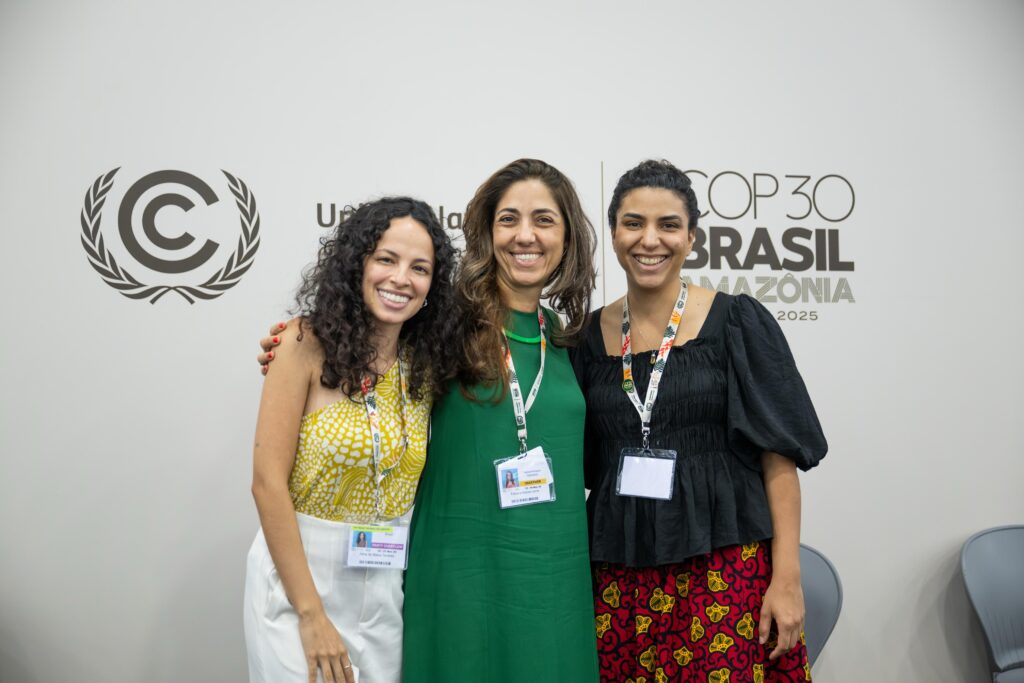
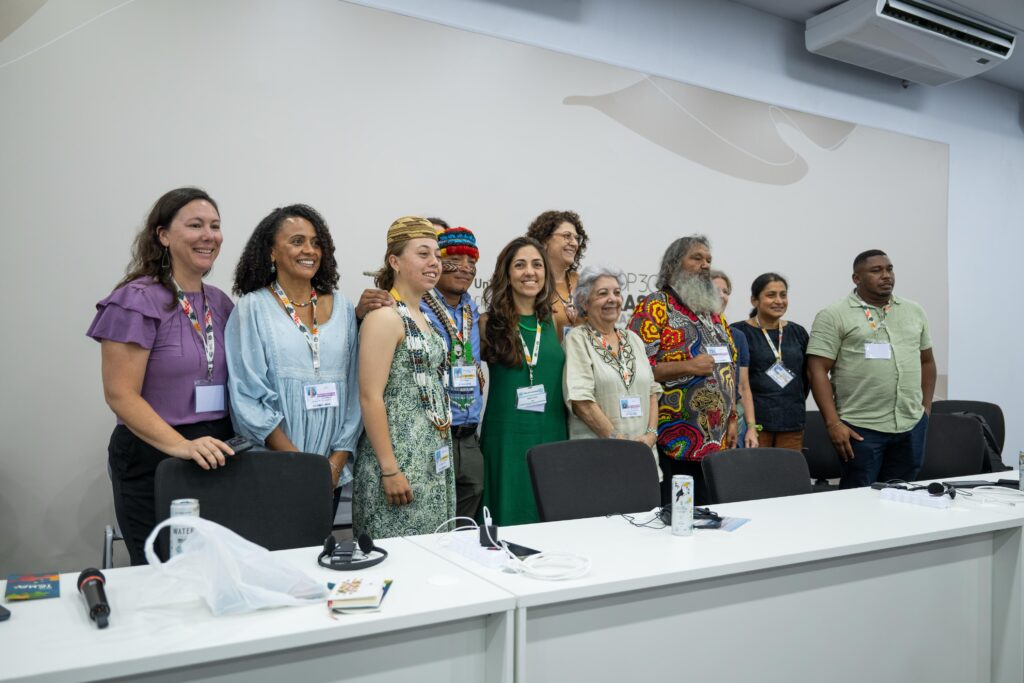
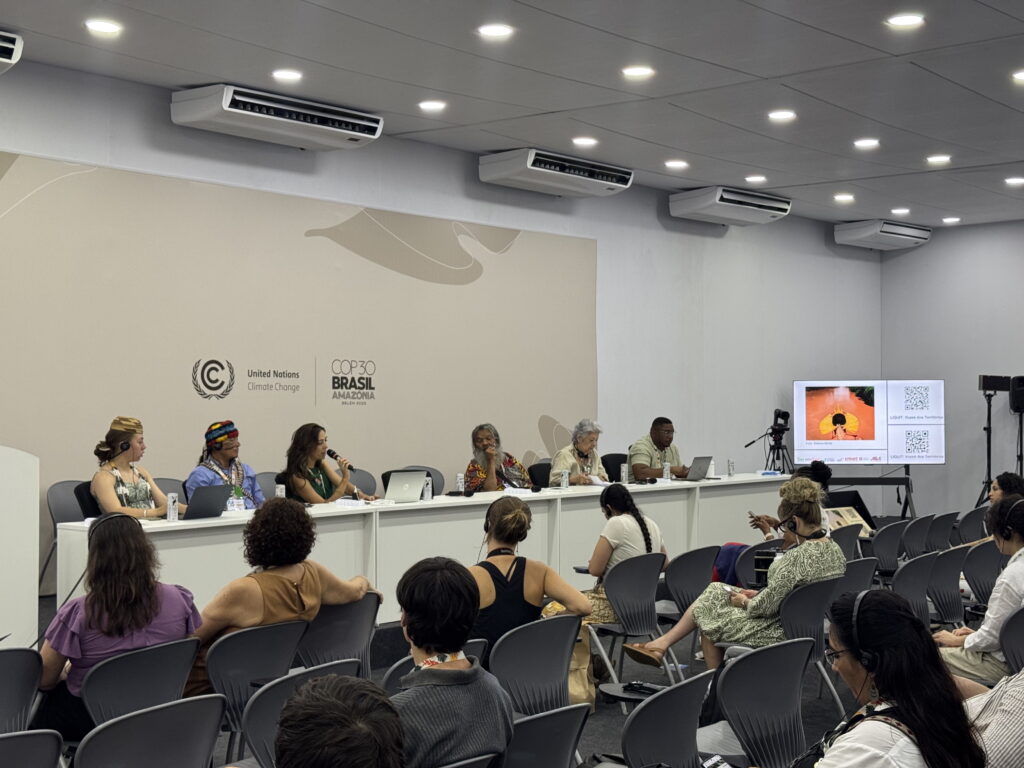
On 13 November 2025, in Belém (PA), we held at the official COP 30 venue the side event featuring the panel titled “The Central Role of Indigenous People and Local Communities in Just Energy Transition”. We brought together Indigenous leaders, Quilombola representatives, researchers, and members of community organisations from different regions of the world to discuss the perspective of local peoples in the implementation of a socially just energy transition. The discussions reinforced the historical protagonism of communities in protecting biodiversity, whose autonomy has been threatened by large-scale decarbonisation projects.
Among the speakers, Ruby Williams from the Yurok Tribe in northern California (USA) and member of Paddle Tribal Waters shared reflections on the recent threat of destruction of sacred tribal sites due to floating offshore wind energy projects. She denounced inadequate environmental studies on the impacts on the Klamath River ecosystem and argued that the federal government violated the people’s sovereignty by failing to consult them on developments in their territory.
Leslie Schultz from Australia, founder of the Ngadju Conservation Aboriginal Corporation, described how mining has profoundly impacted his life and that of his entire community. In his remarks, he emphasised that poverty became part of local reality from the moment communities became dependent on and vulnerable to the economic fluctuations of the mining industry.
Nantu Canelos, from Ecuador and Executive Director of Kara Solar, shared experiences of partnership with the Achuar Indigenous people. In the Ecuadorian Amazon, they develop solar-powered boats to replace petrol engines. He highlighted that the energy transition, when led by forest peoples themselves, strengthens territorial governance and promotes solutions aligned with traditional ways of life.
Fabiana Soares Leme, representing the Institute of Development Studies (IDS) and the LIQUIT project, detailed how the Brazilian socio-environmental movement achieved legislative recognition of Traditional Peoples and Communities, which within the United Nations system corresponds to Local Communities. She noted that this is a key role in initiatives that seek to amplify the voices of these peoples.
Sônia Magalhães, professor at the Federal University of Pará (UFPA), emphasised the lack of questioning regarding energy demand itself. Using the example of hydroelectric dams in Brazil, especially the Tucuruí Hydroelectric Plant, she highlighted cases of ecocide generated by projects labelled as sustainable simply because they incorporate renewable energy. Communities affected by mega-projects suffer profound losses and are subjected to unfair land regularisation processes. Ultimately, most hydroelectric plants do not generate the expected energy output.
Anthropologist David Pereira, from the Federal University of Maranhão, is Quilombola and brought the perspective of Quilombola communities in Brazil, highlighting the need to include these populations in renewable energy debates. His contribution reinforced that energy justice also implies historical reparation, guarantee of territorial rights, and recognition of multiple forms of belonging to land.
Despite different geographical and cultural realities, the testimonies converged in denouncing similar processes of expropriation, invisibilisation, and imposition of large-scale energy projects without prior, free, and informed consultation. The exchanges concluded with the understanding that a just energy transition requires strengthening alliances between peoples and communities, recognising their territorial rights, and incorporating their worldviews into climate policies.
A central reflection emerged from the meeting: local communities do not see themselves as owners of the land but as inseparable from it. This is not about property in a market sense, but about belonging. This vision challenges the dominant paradigm of energy transition based solely on the substitution of energy sources, proposing instead a deeper transformation of the relationships between society, energy, and nature.